|
ONTARIO ROCK GARDEN SOCIETY |
|
|
|
From |
|
Borage Blue |
||
|
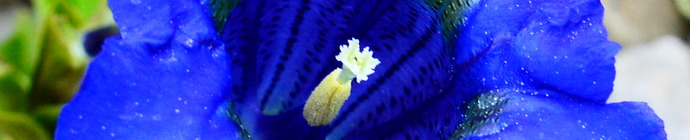
I have a customer who buys seed only of the borage family members. Though there are many colours, the family is well known for that elusive colour. Without question, over the years, the blooming blue beauts blew away broods of brooding brxxxxxxs (got stuck on this one. You can tell that this article has been brewing for a while, but there may still be bloopers in it - may they not bloomerang back on me). Moving on from the introductory groans, I want to talk about mertensias. There are about 50 species in this temperate Northern Hemisphere genus, and they are all perennials. Plants tend to be fairly leafs'. Generally bell-shaped flowers are in clusters along the top of the stems and side shoots. Principal flowering time is in spring. Blue is the colour most associated with the genus, but literature records pink, yellow and white also. I have only seen blue (in different shades) and pink. All the colours have been quality - no dingy here. In common with some other plants, sometimes the buds have one colour but open another. There is sometimes also a lovely transition from one colour at the rim of the bells to the bottom of the calyx. The biggest one that I know is M. virginica, which grows to about 1 m. There are good clusters of flowers atop the stems and the whole plant makes an attractive clump. It is native in the Southwestern counties of Ontario, but so far I have only seen it in the wild in the Allegheny mountains in Pennsylvania, making incredible sheets in early spring deciduous woodland meadows. For a sup-posedly common plant, I have had quite a hard time getting hold of it. By the early part of July the plants go dormant and totally disappear. All the other mertensias that we have reside in our 'scree'. Our scree is fairly clayey subsoil, covered by several inches of gravel, in several descending steps from beside the house to approximately 1.3421 m below. This environment suits them. It should be mentioned that the gravel keeps the subsoil very nice and moist, so that we never have a drying out problem. Among rock gardeners probably the best known is M. sibirica (M. pterocarpa). This is quite adaptable, being happy just a few feet inside the edge of our premiere woodland bed, but flowering much better and longer in the more sunny scree. Basal leaves are heart-shaped and brownish green, but the more juvenile foliage is actually quite bluish in over-all cast. Best bloom is in the spring, but sporadic bloom persists for the bulk of the season. Our plant has thrown a couple of seedlings, but we're not inundated with them. We have never trimmed the plant back, but cutting it back would tidy up the flopping 50 cm stems, and bring back the original nice little mound. This is a substantial plant, not for a normal-sized trough. Our original plant came from Norm Coombe - sadly, by now a number of our plants are memorials, rather than just gifts.
|
||
|
|
||
|
Merlensia lanceolala is a bigger plant on the hillsides, but in our scree it has remained small, elegant and ever so different from the other ones, too, of course. It goes dormant for us. Mertensia maritima inhabits Northern Europe, being found on sea sand. From Iceland-grown seed it suc-ceeded in our scree, but did not persist - we are not sure if it was crittered out of existence or not. When we get more seed we will try again. Blooming for the first time this year was the Himalayan Merlensia echioides. Quite different-looking from the North-American jobbies, the flowers are smaller, but the dark blue-black intensity! Almost a velvetiness. The flowers are on barish (that's bare-ish) scapes, well above the foliage. We have transferred one clump to our mertensia collection. This is part of the latest fashion with us; the drifts of one are combined to form drifts of one genus. To heck with geographical plantings, family plant-ings are equally scientific and far more pleasing aestheti-cally. While several other species mertensia seedlings are com-ing along, I have no record of any other flowering for us. Sue and I have seen mertensias in many different moun-tains in the West, she, in particular, spotted a lovely pink flowered one amid a sea of blue on Gravelly Ridge in Montana. We have liked all the mertensias we have seen, but I do want to mention one in particular.
Mertensia bella
is narrowly distributed in Oregon. It grows in the shade (unlike all
the other mountain ones I have seen), in wet conditions, and goes
dormant. A small, and utterly delightful and desirable plant, this is
high on my list. |
||
|
Because our
newsletter colour budget has been exhausted for the year, I am in the
process of trying to post some illustrations on our ORGS website,
hosted by Peter Gill. Good spring moisture seems essential both in the wild and in the garden. The wet-knee test works: if you've got it, the spot is suitable for mertensia. I can't say for sure about late season conditions, but the areas generally look like they would be very dry from early summer on. In the mountains mertensias can take a fair bit of competition Just a few weeks ago I acquired Mertensia primuloides from Harvey Wrightman. Although this Himalayan plant is reported to be white, yellow and blue in its various incarnations, Harvey only mentions blue. Off the top of my head, I don't remember any other nursery offering rock-garden-suitable mertensias. Apart from this, everything else that we now have in the works came from seed. In addition to the usual seedex sources, Gardens North offers M. sibirica, Rocky Mountain Rare Plants and Northwestern Native Seeds offer a variety of western mertensias. Seed collecting tends to be sparse, and some years the seedexes offer nothing. I have seen no listing for M. bella, but keep hoping. Well, if you're not boraged out yet, begging notes will be carefully considered. Andrew lives, works and gardens in Shelburne, Ontario and has a love affair with a genus for a period and then moves on .. what next, Andrew? |